Many pension funds promote the benefits of voluntary purchases without transparently addressing potential downsides. In this article, we aim to do better. We also highlight the critical issues so that you can make a more informed decision about whether a pension fund purchase truly makes sense for you.
Table of contents
What is a pension fund purchase?
In Switzerland, employees save for their retirement through the pension fund. They and their employer make pension fund contributions each month, which are mandated by law. Many people have gaps in their contributions due to factors such as salary increases, delayed job starts, part-time work, or breaks for travel or childcare. As a result, their retirement savings end up being lower than they could be. Making voluntary contributions to the pension fund can help fill these gaps and boost the retirement pension.
Many people have gaps in their contributions. Reasons for this include salary increases, starting work later, part-time work or breaks for travelling or children. The retirement assets are then lower than they could be.
Buy into the pension fund: pros and cons at a glance
Buying into the pension fund is worthwhile not only because of the usually higher retirement pension:
- You save taxes.
- Disability and death benefits may increase.
- In the event of early retirement, you can use it to cushion the impact of reduced benefits.
| Advantages of a pension fund purchase | Disadvantages of a voluntary pension fund buy-in |
|
|
Buying into the pension fund: When does it make sense?
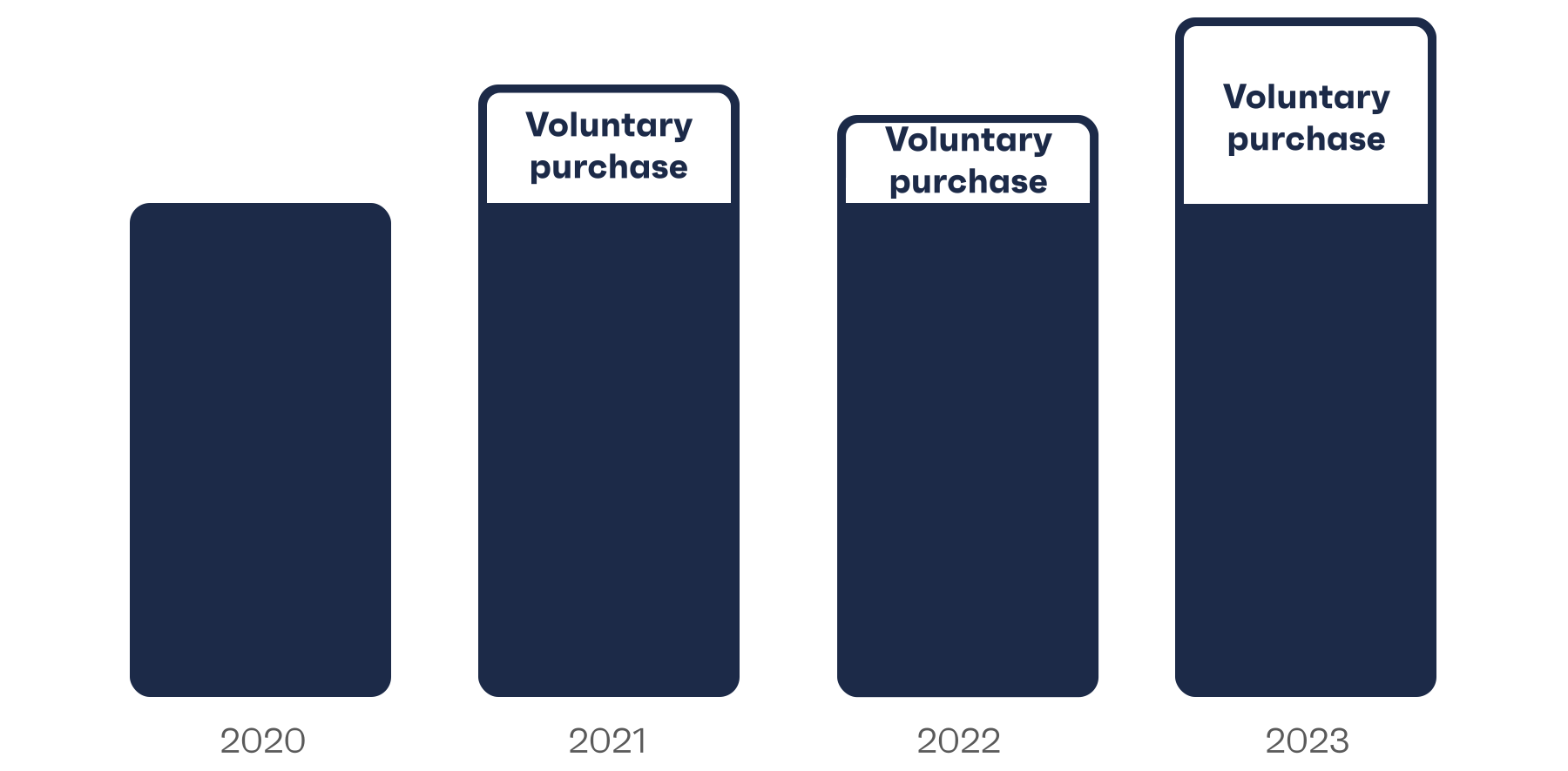
A purchase is especially beneficial in the final years of your career. Salaries tend to be at their highest during this time, along with the associated tax burden. You can alleviate income peaks by making staggered purchases.
The goal should be to use voluntary buy-ins to smooth out income peaks, reducing your annual taxable income (see illustration). If your income falls within a lower tax bracket, a buy-in is less advantageous.
Choosing the right timing
Whether contributing to your pension fund is worthwhile also depends on timing. We distinguish between two scenarios:
- The right time for pension funds with a low funding ratio
- The right time for pension funds with a high funding ratio
For pension funds with a low funding ratio, it’s better to contribute later rather than earlier. Over a shorter time horizon, you can better assess the risks of benefit reductions. You can make contributions up to three years before retirement if you plan a capital withdrawal. If no capital withdrawal is planned, you can contribute up to retirement.
For funds with a high funding ratio, contributing earlier can also be beneficial, especially if you anticipate staying with a pension fund with an exceptionally strong funding ratio until retirement or if the fund uses capital plans or 1e plans.
Tax optimization through early purchases
The tax savings from the purchase are much higher than anticipated. This is due to the pension assets being exempt from wealth taxes, and tax-free investment returns.
If you invest the tax savings in private assets and achieve a corresponding return, the effect of tax savings increases significantly over time.
For a purchase of CHF 10,000 with a holding period of 20 years, the net tax savings total CHF 4,581, which corresponds to an annual return of 2.29%.
| (Purchasing Amount: CHF 10’000) | 20 Years | 10 Years | 5 Years | 3 Years |
| Tax Savings: Voluntary Purchase | 2’000 | 2’000 | 2’000 | 2’000 |
| Tax savings: No Wealth Tax | 1’000 | 500 | 250 | 150 |
| Tax Savings: No Income Tax | 1’075 | 459 | 212 | 124 |
| + Performance achieved on the taxes saved | 1’909 | 702 | 298 | 167 |
| Capital Withdrawal Tax | -1’403 | -1’044 | -900 | -849 |
| Net tax savings | 4’581 | 2’617 | 1’860 | 2’592 |
| Return in % p.a. | 2.29 % | 2.62 % | 3.72 % | 5.31 % |
Note: 3% is hardly possible in a normal pension fund due to the redistribution which is taking place, but it is possible in 1e management plans or in the 3rd pillar.
A purchase does not always improve the retirement pension
A purchase into the pension fund does not automatically increase your retirement pension. This is due to two factors:
- In the 2nd pillar, there are two schemes: a mandatory and a non-mandatory one.
- Pension funds use different models to calculate the pension.
Mandatory portion before the extra-mandatory portion
Since the mandatory portion provides both a minimum interest rate* on retirement savings and a minimum pension conversion rate, it is advisable to first close gaps in the mandatory portion before contributing to the extra-mandatory portion. This is primarily possible if the mandatory and extra-mandatory portions are insured through two separate pension funds. Check with your pension fund to see if you can contribute exclusively to the mandatory portion.
If contributing to the mandatory portion isn’t possible or if you only have contribution potential in the extra-mandatory portion, consider the financial health of your pension fund. If the funding ratio is well above 100%, this is a positive sign. If it is close to or below 100%, contributions are less attractive. You should be prepared for the possibility that benefits in the extra-mandatory portion could be further reduced to offset conversion losses in the mandatory portion under the BVG.
Enveloping model: Caution with mixed conversion rate
Many pension funds utilize an enveloping model. This means that a standardized conversion rate is applied to the entire retirement assets, regardless of whether they come from the mandatory or non-mandatory portion.
If the mandatory portion has been fully utilized, any voluntary contributions are then allocated to the non-mandatory portion. In some cases, this could result in a pension that is lower than it would have been without the voluntary contribution.
What requirements do I need to meet?
For a purchase to be made into the pension fund, two essential conditions must be fulfilled:
- You must have a contribution gap, which is also referred to as your purchasing potential.
- You must have repaid any advance withdrawals related to the home ownership promotion.
Anyone who does not meet these conditions will not be able to make a purchase.
Maximum purchase amount
The maximum purchase amount differs for each individual and is generally specified on your pension certificate.
The pension fund calculates your benefits based on your insured salary, assuming it remains constant from age 25. This approach determines the maximum possible retirement assets. The difference between this amount and your actual savings is your maximum purchase amount.
Until when is it possible to make a purchase into the pension fund?
If you do not plan to withdraw your capital, you can make additional purchases into your pension fund until retirement, usually up to age 65. Some regulations allow purchases up to one month before retirement. If your retirement plan allows it, you can make buy-ins into the pension fund until the age of 70. Please check with your pension fund for the specific deadline.
Observe blocking periods for capital withdrawals
Following a purchase into the pension fund, capital withdrawals are subject to a three-year blocking period. Non-compliance may result in tax return adjustments or additional tax proceedings. Pensions remain unaffected.
Please use our lump-sum withdrawal calculator to determine whether a lump-sum withdrawal or a pension best meets your needs.
What should I consider when paying into my pension fund?
Check liquidity
The amount you invest is typically locked until retirement. Can you manage without that money until you retire? If your answer is no, you should refrain from making the purchase.
Review disability and death benefits
The treatment of voluntary purchases upon death depends on the specific pension fund.
In technical terms, this is referred to as “full reimbursement “. This means that the voluntary buy-ins are paid out to the beneficiaries in addition to the survivors’ pension. If the pension fund does not grant a refund, the money paid in voluntarily is used to finance the survivors’ pensions.
Please clarify the following points:
- Does the voluntary purchase enhance pension benefits for surviving dependants?
- Is a lump-sum death benefit provided in addition to regular pension benefits?
You can find out more about this topic in our article “Survivors’ pension“.
Married couples should choose the better-performing pension fund
Married couples who are both employed have an additional opportunity to optimize pension fund contributions. Since their incomes are combined in the tax return, couples can compare their respective pension funds and prioritize the one that is financially stronger and offers better benefits.
Repurchasing after a divorce
In the event of a divorce, couples are protected. The retirement savings accumulated during the marriage are split equally, regardless of marital property regime. An exception applies if contributions were made using assets classified as separate property, provided such assets can be proven.
If you transferred part of your pension fund assets due to a divorce, you may repay this amount without restriction.
Repayment of advance withdrawals for residential property is not required. The three-year blocking period for capital withdrawals also does not apply in this case.
Check regulations
Pension funds may set their own rules in addition to legal requirements. Please review your pension fund’s regulations and contact your fund directly for details.
3 examples from practice:
- Swiss Life: Purchase is possible up to 1 month before retirement or early retirement. The repayment depends on the pension plan. You must obtain a non-binding offer before making a purchase.
- Axa Professional Invest: Purchases are possible from CHF 1,000 and until retirement.
- ASGA Pension Fund: Purchases are permitted until retirement. A maximum of 3 payments is possible per year. You must submit a questionnaire to calculate the maximum purchase amount. The refund differs depending on the pension plan.
Financing the purchase with pillar 3a
You may use pillar 3a assets to buy into the pension fund. However, this is rarely beneficial for tax purposes, as such transfers are not deductible from your income.
If you lack liquidity in your free assets, this approach may still be appropriate. It enables you to enhance your pension provision, even with a limited budget.
Moving to Switzerland
If you immigrated after 2005 and have never been affiliated with a pension fund, you may contribute up to 20% of your insured salary per year for the first five years.
Return to employment
If you are returning to employment from self-employment, your maximum purchase may be reduced if you have made significant contributions to pillar 3a.
Alternatives to voluntary purchases
Private pension: pillar 3a
The tax-advantaged pillar 3a is another alternative to pension fund contributions. If both spouses are employed and one is covered by a pension fund, both can contribute the annual maximum amount to pillar 3a and deduct it from their taxable income.
From 2025, you can also close contribution gaps retroactively for up to ten years. These contributions are fully tax-deductible. Learn more in our article on “pillar 3a top-up payments”.
Free assets: invest money privately
The answer to the question of whether it makes sense to buy into the pension fund also depends on what else you do with the money. If you don’t invest it and even pay negative interest rates, contributing to a pension fund may be more worthwhile. If you can invest the money privately with good returns, the situation changes.
If you decide to invest the money yourself, choosing the right provider is crucial. Since May 2024, finpension has an investment solution for free assets. With us, you benefit from low fees and fee-free foreign currency exchanges. You can also choose between preconfigured or customizable investment strategies. To compare providers, see our comparison of digital asset managers.
Making a voluntary purchase in the 1e plan from finpension
1e plans are an attractive alternative for second-pillar savings. In 1e plans, each insured person has an individual account, avoiding redistribution from active to retired participants. Learn more about the benefits of 1e plans in our detailed article.
In the 1e plan from finpension, purchases are possible up to 3 years before retirement. Generally, full reimbursement is included. However, different rules may apply depending on the pension plan.
How purchasing works
After entering your details, we will calculate your maximum purchase amount and display the payment details.
Log in to your 1e plan.
Select “Voluntary Purchase” and then choose “Calculate Purchase.”
Further reading:


